In our readings, the terms cybertyping and identity tourism are introduced to us. Nakamura sets up her article, "Cybertyping and the Work of Race in the Age of Digital Reproduction", by stating that software engineers and academics both enjoy creating new words and jargon to describe something new. Using the example of "new media", she explains how they require their own set of descriptive terminologies and conceptual frameworks, stating how they are so inherently different from their precursors. She coins the term cybertype to "describe the distinctive ways that the Internet propagates, disseminates, and commodifies images of race and racism" (pg. 3). Different from stereotype, for those describe the machine functions, cybertypes are an even faster way to translate information. Identity tourism on the other hand is used to describe a "disturbing" occurrence that Nakamura began noticing in Internet chat communities--in essence, it's a term to describe the ability to temporarily "take on" someone else's identity to fulfill some sort of "lived truth" (pg.14).
Street Fighter II, the application.
Nakamura targets the while male as the main audience for identity tourism, crossing over racial boundaries for a short period of time via play or recreation (Nakamura 2007, pg 299). Street Fighter II seems to be the epitome of this, using cultural knowledge to create stereo (or rather, cyber) types of different nations. Characters such as Dahlsim exhibit exaggerated traits of what one thinks of concerning India. He is a skinny monk with supernatural powers which allow him to stretch his limbs. All the characters exemplify this sort of cybertyping not only from their appearance, but to their way of speech and the settings they are surrounded in. Nakamura would argue that every time we play as one of these radically cybertyped characters, we are in essence partaking in identity tourism. The characters represent different avatars, and if I chose to, I could fantasize about roleplaying the character of a buff military dude or the lone Asian female.
As you can see from the video, Street Fighter II serves to perpetuate already existing stereotypes through the virtual realm. It also allows users to "travel the world" through each tournament, giving them an experience of each and every culture. Thawk, the Indian character, is portrayed outside among a circle of other native Americans.
Works Cited
Nakamura, L. (2002). Cybertypes: Race, Ethnicity, and Identity on the Internet. New York: Routledge.
Nakamura, L. (2007). Race in/for Cyberspace: Identity tourism ad racial passing on the Internet. In D. Bell and B. M. Kennedy (Ed.),The Cybercultures Reader (2nd Ed.) (pp. 297-304). London and New York: Routeledge.
Thursday, October 21, 2010

Friday, October 8, 2010
blog 7, Gender Stereotypes
Gender stereotypes, you are SUCH a big deal! Do you REALIZE the amount of hassle I have to go through, just to define that you exist and rule in the minds of whoever comes along? You... you and your rhetoric. If you made a stronger argument, or rather--if you would STOP arguing your case, we wouldn't be having this discussion.

Super Mario 2 is an amazing game, in all its 8-bit glory. I remember playing this bad boy as a little kid. I... admittedly, was a tom boy. I trampled over my gender stereotype and I ate it for breakfast, daily. I played with batman and robin figurines, and I hated pink. Loathed it. As far as I was concerned, overly pink items could seriously fall off a cliff and die. So you could only imagine my reaction when I picked up this little game. Do you know why? Do you know why I was so surprised? It's hard. Playing as my favorite green dude just wasn't helping. And so I quickly found out the advantages of playing the dainty pink atrocity. She presented a unique trait different from the rest: the ability to float. The user is able to choose between 4 characters: Mario, Luigi, Toadstool, or Princess Peach, and they each have their own unique skills.. but really? None of them are really helpful in battling evil and unjust mushrooms. Except for Peach. And I can only imagine how the opposite sex reacted to this surprise. Did they squirm and try to avoid playing the easier route, as the pink atrocity, or did they battle it out "like a man" and play as the heroic Mario?
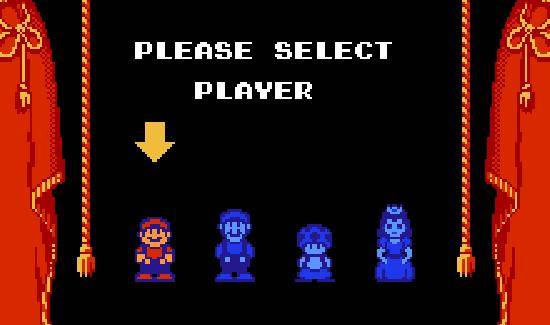
Yes, we can dissect the avatars and how the user interacts with them. Yes, we can even say that Peach's unique trait may have forced the male gender to wear the female avatar, effectively letting them to role play as a girl or what not. Really, it is to my opinion that Super Mario Bros. 2 just... is. It's a story of a plumber and his brother, with his love interest Peach and.. some mushroom friend? When they chose to make up the characters, I don't believe they were actively seeking to appeal to whatever audience for whatever reasons, aside from the fact that they were expecting mostly male gamers. Looking at the history of the game, these characters were made to fit a fairytale. The first Mario game allows the user to play as average plumber Mario, on a quest to save the princess. There were some comments stating how Peach is stereotyped as thin and pretty, but c'mon, really? She's a PRINCESS. What man wants to rescue a fat slob high up in a castle? We make these characters to represent the ideal, what we think a princess should look like. Mario and Luigi are an awkward set of brothers. One's a little chubby, the other is awkwardly tall. This set allows the user to roleplay as the underdog, as the average Joe in an attempt to attain ultimate awesomeness.
Now, if I were to act like Schleiner and dissect this game, what kinds of conclusions would I come up with? Well, for starters, I'd open this up stating what a messy can of worms Mario Bros. 2 makes itself out to be. This game allows the user to be WHOEVER he/she wants to be. As a male, I could effectively play as Princess Peach and put on that "drag" mentality. I could make Princess Peach be that positive role model for myself, an all high and mighty princess gettin' down and dirty to save the kingdom. Mario, the positive role model, enduring this tripping world filled with talking mushrooms and crazy egg-shooting dinosaurs in order to save this gorgeous princess. I could be this seemingly gender-less toad and do whatever I want. Really, it's all up to the viewer. Schleiner's view of "gender configurations" incorporates the idea that "a single subject may morph and oscillate between [various] positions or roles, or gravitate more strongly toward one player/subject position". In essence, I could take Peach and make her my female gaze play toy, I could role-play as a bad ass dress wearin' destroyer, or she could just be my happy little role model. The same could be said towards all the characters. As a human being, I have the ability to think whatever I want to think and do whatever I want to do with these avatars, whether I choose to adhere to my gender stereotype, or experiment in my mind how wearing drag would be.
Super Mario Bros. 2 complicates gender stereotypes because it's not just cut and dry. The dainty princess kills things. You can be a genderless mushroom. Or a chubby Italian plumber. Really, I think this game forces men to play as the chick. Why else would they make it so difficult, unless you were the princess?

Schleiner, Ann-Marie. "Does Lara Croft Wear Fake Polygons? Gender and Gender-Role Subversion in Computer Adventure Games." MIT Press 34.3 (2001): 221-26. Web. 7 Oct 2010.
Super Mario 2 is an amazing game, in all its 8-bit glory. I remember playing this bad boy as a little kid. I... admittedly, was a tom boy. I trampled over my gender stereotype and I ate it for breakfast, daily. I played with batman and robin figurines, and I hated pink. Loathed it. As far as I was concerned, overly pink items could seriously fall off a cliff and die. So you could only imagine my reaction when I picked up this little game. Do you know why? Do you know why I was so surprised? It's hard. Playing as my favorite green dude just wasn't helping. And so I quickly found out the advantages of playing the dainty pink atrocity. She presented a unique trait different from the rest: the ability to float. The user is able to choose between 4 characters: Mario, Luigi, Toadstool, or Princess Peach, and they each have their own unique skills.. but really? None of them are really helpful in battling evil and unjust mushrooms. Except for Peach. And I can only imagine how the opposite sex reacted to this surprise. Did they squirm and try to avoid playing the easier route, as the pink atrocity, or did they battle it out "like a man" and play as the heroic Mario?
Yes, we can dissect the avatars and how the user interacts with them. Yes, we can even say that Peach's unique trait may have forced the male gender to wear the female avatar, effectively letting them to role play as a girl or what not. Really, it is to my opinion that Super Mario Bros. 2 just... is. It's a story of a plumber and his brother, with his love interest Peach and.. some mushroom friend? When they chose to make up the characters, I don't believe they were actively seeking to appeal to whatever audience for whatever reasons, aside from the fact that they were expecting mostly male gamers. Looking at the history of the game, these characters were made to fit a fairytale. The first Mario game allows the user to play as average plumber Mario, on a quest to save the princess. There were some comments stating how Peach is stereotyped as thin and pretty, but c'mon, really? She's a PRINCESS. What man wants to rescue a fat slob high up in a castle? We make these characters to represent the ideal, what we think a princess should look like. Mario and Luigi are an awkward set of brothers. One's a little chubby, the other is awkwardly tall. This set allows the user to roleplay as the underdog, as the average Joe in an attempt to attain ultimate awesomeness.
Now, if I were to act like Schleiner and dissect this game, what kinds of conclusions would I come up with? Well, for starters, I'd open this up stating what a messy can of worms Mario Bros. 2 makes itself out to be. This game allows the user to be WHOEVER he/she wants to be. As a male, I could effectively play as Princess Peach and put on that "drag" mentality. I could make Princess Peach be that positive role model for myself, an all high and mighty princess gettin' down and dirty to save the kingdom. Mario, the positive role model, enduring this tripping world filled with talking mushrooms and crazy egg-shooting dinosaurs in order to save this gorgeous princess. I could be this seemingly gender-less toad and do whatever I want. Really, it's all up to the viewer. Schleiner's view of "gender configurations" incorporates the idea that "a single subject may morph and oscillate between [various] positions or roles, or gravitate more strongly toward one player/subject position". In essence, I could take Peach and make her my female gaze play toy, I could role-play as a bad ass dress wearin' destroyer, or she could just be my happy little role model. The same could be said towards all the characters. As a human being, I have the ability to think whatever I want to think and do whatever I want to do with these avatars, whether I choose to adhere to my gender stereotype, or experiment in my mind how wearing drag would be.
Super Mario Bros. 2 complicates gender stereotypes because it's not just cut and dry. The dainty princess kills things. You can be a genderless mushroom. Or a chubby Italian plumber. Really, I think this game forces men to play as the chick. Why else would they make it so difficult, unless you were the princess?
Schleiner, Ann-Marie. "Does Lara Croft Wear Fake Polygons? Gender and Gender-Role Subversion in Computer Adventure Games." MIT Press 34.3 (2001): 221-26. Web. 7 Oct 2010.
Tuesday, October 5, 2010
Notes:
Male gaze: woman's bodies are objectified, seen as an item point for men's pleasure. "traditional exhibitionist role" to men's "voyeuristic role". Men - aggressive and female - passive.
The men are portrayed in positions of power by visual hierarchy (Function ranking).
Some LEARNING principles for looking at the CYBER world
psychosocial Moratorium = learners or...people on the web using VR can take risks in a space where real-world consequences are lowered (Gee using Erickson's Idea 208).
Ex: using avatars and having personal web pages
Problem: doesn't necessarily exist, without real consequence. Virtual and non-virtual mix in RL.
Overall:
Identity principle: learning involves taking on and playing with identities in such a way that the learner has real choices (in developing the virtual identity) and ample opportunity to mediate on the relationship between new identities and old ones.
Playing Games and Identity: these three never separate
Virtual Identity - one's identity as virtual character/person. (the character)
RealWorld Identity: a non virtual playing a computer game. Constraints in Real World identities. (the gamer)
Projective Identity: the interactions between RW identity and virtual identity. When RW projects their values onto the virtual identity.
ex: I want a Lara Croft who has morals and doesn't kill animals.
Multimodal Principle: meanings and knowledge are built up through various modalitites.
The men are portrayed in positions of power by visual hierarchy (Function ranking).
Some LEARNING principles for looking at the CYBER world
psychosocial Moratorium = learners or...people on the web using VR can take risks in a space where real-world consequences are lowered (Gee using Erickson's Idea 208).
Ex: using avatars and having personal web pages
Problem: doesn't necessarily exist, without real consequence. Virtual and non-virtual mix in RL.
Overall:
Identity principle: learning involves taking on and playing with identities in such a way that the learner has real choices (in developing the virtual identity) and ample opportunity to mediate on the relationship between new identities and old ones.
Playing Games and Identity: these three never separate
Virtual Identity - one's identity as virtual character/person. (the character)
RealWorld Identity: a non virtual playing a computer game. Constraints in Real World identities. (the gamer)
Projective Identity: the interactions between RW identity and virtual identity. When RW projects their values onto the virtual identity.
ex: I want a Lara Croft who has morals and doesn't kill animals.
Multimodal Principle: meanings and knowledge are built up through various modalitites.
Friday, October 1, 2010
Blog 6, Avatar.
How does Avatar separate gender?
I see Avatar placing men and women into their stereotypically played out roles. The men play the leading roles while the women are merely supporting actors. We can see this with Jake, for the story revolves around him, and his support character is his love interest. They place the general as a male character, having authority over all divisions. Even in the Navi part, the chief is a male character. They also stereotype male as being more aggressive and prone to action, as seen in all the battle scenes. Noteably, there are female characters who are portrayed as strong characters in battle, but we see them as different--going against the norm for they are so few and far between.
Jake plays a few contradictory identities in this movie. First of all, he's a disabled white marine who is looked upon as an outcast within his marine division. Then we have Jake Sully, the amazing Navi'i outcast who rises up to become the Navi'i's hero. He's playing both sides of the fence, able to identify with two separate cultures and thus carving out separate identities for himself. We can view the human version of Jake Sully as a man who is without hope, a disabled working man who has to join the army in order to obtain his legs back. We can also view him as a Navi who is rich in athletic ability and natural resources--with the dragon serving as a huge status symbol giving him power. We could say that Jake Sully's life as a Navi has more opportunities and freedom than his human counterpart. We can in turn relate this to our lives and our interactions with the web. The web can serve to open up different avenues and explore different identities which are not possible outside of the digital realm. We have more power to sway how we want to portray ourselves in different digital realms, with some people giving up their normal lives outside of technology to persue those online, such as in a popular massively multiplayer online role-playing game (MMORPG), World of Warcraft (WoW).
I see Avatar placing men and women into their stereotypically played out roles. The men play the leading roles while the women are merely supporting actors. We can see this with Jake, for the story revolves around him, and his support character is his love interest. They place the general as a male character, having authority over all divisions. Even in the Navi part, the chief is a male character. They also stereotype male as being more aggressive and prone to action, as seen in all the battle scenes. Noteably, there are female characters who are portrayed as strong characters in battle, but we see them as different--going against the norm for they are so few and far between.
Jake plays a few contradictory identities in this movie. First of all, he's a disabled white marine who is looked upon as an outcast within his marine division. Then we have Jake Sully, the amazing Navi'i outcast who rises up to become the Navi'i's hero. He's playing both sides of the fence, able to identify with two separate cultures and thus carving out separate identities for himself. We can view the human version of Jake Sully as a man who is without hope, a disabled working man who has to join the army in order to obtain his legs back. We can also view him as a Navi who is rich in athletic ability and natural resources--with the dragon serving as a huge status symbol giving him power. We could say that Jake Sully's life as a Navi has more opportunities and freedom than his human counterpart. We can in turn relate this to our lives and our interactions with the web. The web can serve to open up different avenues and explore different identities which are not possible outside of the digital realm. We have more power to sway how we want to portray ourselves in different digital realms, with some people giving up their normal lives outside of technology to persue those online, such as in a popular massively multiplayer online role-playing game (MMORPG), World of Warcraft (WoW).
Thursday, September 16, 2010
Blogo number 4, the fourth blog to rule them all....
1. Using the virtual and RL communities you are a part of for
evidence, describe how you agree and/or disagree with Bell and
Bauman’s notions of virtual communities as peg communities (250-
300 words).
People may react and behave differently in different environments, but it is true that their current mindsets will remain fairly consistent. People are people, across the board, and no matter what the environment they will bring across who they are and the mindsets they currently adhere to. As far as communities along the virtual and real world, I would argue that they adhere to pretty much the same standards. In all of these environments, we hang up a part of ourselves as a part of our identity, which exemplifies Bell's idea that online communities act as peg communities (pg. 254)
Communities act on several different levels. It's a broad term, used to group people together based upon interest, location, beliefs, etc. We can start off at the top of the hierarchy chart of communities, say for example, the Tri-Cities. Because I live here, and my neighbors live here, we are part of the Tri-City community. From there, we can define smaller communities such as the separate cities, or perhaps places in which we work. An optional community that I choose to take part in would be my church. It is evident that there are communities that I inherently belong in whether I like it or not and those of which I actively choose so on my own.
Virtual communities give off this same sort of rapport as well, grouping people into communities that are inherent and/or selective based upon the user's actions. An easy example would be to use Facebook--because we all know everyone who /matters/ has a Facebook. We all belong to the FB community and do just fine. We can sub categorize based upon what schools we decide to list ourselves as having attended, where we live, etc. If I so decided, I could join a FB group based upon interest and/or likes.
For Assignment #2, I'd like to use Facebook and deviantART to compare and contrast different types of communities. Facebook is like the umbrella community while deviantART is a selective, interest based site.
Bell, David. The Cybercultures Reader. 2nd. 1. New York, NY: Routledge, 2000. 254-63.
evidence, describe how you agree and/or disagree with Bell and
Bauman’s notions of virtual communities as peg communities (250-
300 words).
People may react and behave differently in different environments, but it is true that their current mindsets will remain fairly consistent. People are people, across the board, and no matter what the environment they will bring across who they are and the mindsets they currently adhere to. As far as communities along the virtual and real world, I would argue that they adhere to pretty much the same standards. In all of these environments, we hang up a part of ourselves as a part of our identity, which exemplifies Bell's idea that online communities act as peg communities (pg. 254)
Communities act on several different levels. It's a broad term, used to group people together based upon interest, location, beliefs, etc. We can start off at the top of the hierarchy chart of communities, say for example, the Tri-Cities. Because I live here, and my neighbors live here, we are part of the Tri-City community. From there, we can define smaller communities such as the separate cities, or perhaps places in which we work. An optional community that I choose to take part in would be my church. It is evident that there are communities that I inherently belong in whether I like it or not and those of which I actively choose so on my own.
Virtual communities give off this same sort of rapport as well, grouping people into communities that are inherent and/or selective based upon the user's actions. An easy example would be to use Facebook--because we all know everyone who /matters/ has a Facebook. We all belong to the FB community and do just fine. We can sub categorize based upon what schools we decide to list ourselves as having attended, where we live, etc. If I so decided, I could join a FB group based upon interest and/or likes.
For Assignment #2, I'd like to use Facebook and deviantART to compare and contrast different types of communities. Facebook is like the umbrella community while deviantART is a selective, interest based site.
Bell, David. The Cybercultures Reader. 2nd. 1. New York, NY: Routledge, 2000. 254-63.
Monday, September 13, 2010
Notes:
Access is the opportunity to use technology whenever you want to use it or need to use it.
Burbles:
Links are not all of the same type.
Ex: Some links take you out of a site and some keep you in a website.
Reading the author is trying to put on you with the link.
Audio, video, static image, text, broken links.
Links use and placement is a vital way tacit assumptions and values (ideologies) of the design are shown in hypertext.
Ex: highlighting the word devil with a link to GW.
Link to PETA's website suggests a relationship that you are for animals.
Links change the way material is read and understood.
Ex: Rock music and drug info.
Ex: Drug info site, browsing the web, finding links to bands. Association implies that these bands have drug problems.
Links control access to information, offer possible pathways of movement, suggests relationships between items.
Activity: Find a likeable website. 2-3 sentences how links are like the trope.
Burbles:
Links are not all of the same type.
Ex: Some links take you out of a site and some keep you in a website.
Reading the author is trying to put on you with the link.
Audio, video, static image, text, broken links.
Links use and placement is a vital way tacit assumptions and values (ideologies) of the design are shown in hypertext.
Ex: highlighting the word devil with a link to GW.
Link to PETA's website suggests a relationship that you are for animals.
Links change the way material is read and understood.
Ex: Rock music and drug info.
Ex: Drug info site, browsing the web, finding links to bands. Association implies that these bands have drug problems.
Links control access to information, offer possible pathways of movement, suggests relationships between items.
Activity: Find a likeable website. 2-3 sentences how links are like the trope.
Thursday, September 9, 2010
Blogo numero threeeeee.
"Oh my god, so many links."
The first thoughts that spill from my mind as I enter yahoo's website. Where do I start? What am I looking for? This is complete and utter--oh wait. Picture. Portal. Riiight.
Burnett and Marshall explain how this very busy page came to be. Stemming from hypertext mark up languages on over to links, yahoo.com is a massive conglomerate of links abound. Taken from their standpoint, the web is nothing too extraordinary. It seemed as if it were an eventual child to birthed from all these different media sources. Yahoo gives the viewer the means to find whatever it is they want on the web, and they do so by organizing it accordingly. Links in the form of pictures and diagrams, moving images meant to capture and hold the user's attention sit with the intention of waving the user down. I find it interesting that they provide links to outside resources that then point back to them, creating a sort of web-clique.
This snapshot taken from yahoo.com as it stands today accurately depicts the web, in my eyes. The web came to around as a hodgepodge of items and links and technology, and so thus, we have an equally created hodgepodge to help us navigate through the spidery and sometimes difficult to navigate, web.

While this is super nice and seemingly useful, I find that having so many elements, so many pictures, despite how "organized" it is detracts away from my experience--if not once calmed peace. It is mentioned that sites such as these are helpful in steering the user to helpful items, but I believe yahoo.com does it at a price that I don't really want to give up. Sites such as google.com provide the same services while keeping a nice, clean, sleek appeal. Google is my go-to man for all my needs--my email, my email... my.. basic daily functions, driving directions, hits for news. Google is so successful at what it does, it has been incorporated outside the web in our daily language, "I don't know.. why don't you just Google that?"

And that, I will.
"Web Theory": Burnett, Robert; Marshall, P. David. "Web Theory: An Introduction". 2003. Routledge.
The first thoughts that spill from my mind as I enter yahoo's website. Where do I start? What am I looking for? This is complete and utter--oh wait. Picture. Portal. Riiight.
Burnett and Marshall explain how this very busy page came to be. Stemming from hypertext mark up languages on over to links, yahoo.com is a massive conglomerate of links abound. Taken from their standpoint, the web is nothing too extraordinary. It seemed as if it were an eventual child to birthed from all these different media sources. Yahoo gives the viewer the means to find whatever it is they want on the web, and they do so by organizing it accordingly. Links in the form of pictures and diagrams, moving images meant to capture and hold the user's attention sit with the intention of waving the user down. I find it interesting that they provide links to outside resources that then point back to them, creating a sort of web-clique.
This snapshot taken from yahoo.com as it stands today accurately depicts the web, in my eyes. The web came to around as a hodgepodge of items and links and technology, and so thus, we have an equally created hodgepodge to help us navigate through the spidery and sometimes difficult to navigate, web.

While this is super nice and seemingly useful, I find that having so many elements, so many pictures, despite how "organized" it is detracts away from my experience--if not once calmed peace. It is mentioned that sites such as these are helpful in steering the user to helpful items, but I believe yahoo.com does it at a price that I don't really want to give up. Sites such as google.com provide the same services while keeping a nice, clean, sleek appeal. Google is my go-to man for all my needs--my email, my email... my.. basic daily functions, driving directions, hits for news. Google is so successful at what it does, it has been incorporated outside the web in our daily language, "I don't know.. why don't you just Google that?"

And that, I will.
"Web Theory": Burnett, Robert; Marshall, P. David. "Web Theory: An Introduction". 2003. Routledge.
Wednesday, September 1, 2010
Blog # 2
1. What exactly is the digital divide? (150-200 words)
The digital divide is the separation of literacy level or access to technology between groups and communities. In other words, it's that profound gap that occurs between people when technology tries to proceed as the forerunner without making sure everyone else is on board. Because we have put so much emphasis on technology in our culture, there exists a group of people without the proper knowledge to use it, or even in some cases, gain access to it. It is this separation in being able to utilize technology which defines the "digital divide". Without the sufficient access or knowledge to technology, it creates an economic gap, hindering and even compounding those without it. Consider a family who is already in a poor spot financially, without the funds to afford a computer. Without access to the internet, to a computer to type, this could hinder their student's grades at school, potentially leading to a minimum wage job.
Waschauer notes, "In addition, the notion of a digital divide - even in its broadest sense - implies a chain of causality, i.e., that lack of access (however defined) to computers and the Internet harms life chances. While this point is undoubtedly true, the reverse is equally true; those who are already marginalized will have fewer opportunities to access and use computers and the Internet. In fact, technology and society are intertwined and co-constitutive, and this complex interrelationship makes any assumption of causality problematic."
2. Can you think of any other metaphors besides the office
metaphors used with Windows and Macintosh operating systems that
might be better? How come these might work better? (150-200
words)
Facebook? Without having a facebook account, the current users may regard the others as non-existent and without sway in their affairs decided upon via the website. It is centered around communities of people and communication. Without that communication, it's like being part of the digital divide. Being a part of the lower strata, compounding yourself into a tiny not-so-technological hole within society.
I honestly can't think of any better metaphors, for the facebook reference relies on the usage of a technological device. Although this may be another reason why NOT having that technology or literacy towards it serves to further separate communities and society.
The digital divide is the separation of literacy level or access to technology between groups and communities. In other words, it's that profound gap that occurs between people when technology tries to proceed as the forerunner without making sure everyone else is on board. Because we have put so much emphasis on technology in our culture, there exists a group of people without the proper knowledge to use it, or even in some cases, gain access to it. It is this separation in being able to utilize technology which defines the "digital divide". Without the sufficient access or knowledge to technology, it creates an economic gap, hindering and even compounding those without it. Consider a family who is already in a poor spot financially, without the funds to afford a computer. Without access to the internet, to a computer to type, this could hinder their student's grades at school, potentially leading to a minimum wage job.
Waschauer notes, "In addition, the notion of a digital divide - even in its broadest sense - implies a chain of causality, i.e., that lack of access (however defined) to computers and the Internet harms life chances. While this point is undoubtedly true, the reverse is equally true; those who are already marginalized will have fewer opportunities to access and use computers and the Internet. In fact, technology and society are intertwined and co-constitutive, and this complex interrelationship makes any assumption of causality problematic."
2. Can you think of any other metaphors besides the office
metaphors used with Windows and Macintosh operating systems that
might be better? How come these might work better? (150-200
words)
Facebook? Without having a facebook account, the current users may regard the others as non-existent and without sway in their affairs decided upon via the website. It is centered around communities of people and communication. Without that communication, it's like being part of the digital divide. Being a part of the lower strata, compounding yourself into a tiny not-so-technological hole within society.
I honestly can't think of any better metaphors, for the facebook reference relies on the usage of a technological device. Although this may be another reason why NOT having that technology or literacy towards it serves to further separate communities and society.
Tuesday, August 31, 2010
Notes:
Reading,
At = style
And reading,
Through = content
Finding the differences between the meaning and the stylistic choices of font to convey deeper meaning.
Ideology behind books and binding. All elements within the book convey a deeper message.
1. Why is it so important in an attention and information economy to look AT things?
To grab the initial first impression. With seeing the style immediately, you are able to obtain the item which holds the content. Makes the information more valuable in an attention economy.
The AT is subjective, credibility is based upon the user's set of aesthetics.
AT provides ethos--if it's a journal, it should adhere to that style, implies that it is a credible source through style.
2.
At = style
And reading,
Through = content
Finding the differences between the meaning and the stylistic choices of font to convey deeper meaning.
Ideology behind books and binding. All elements within the book convey a deeper message.
1. Why is it so important in an attention and information economy to look AT things?
To grab the initial first impression. With seeing the style immediately, you are able to obtain the item which holds the content. Makes the information more valuable in an attention economy.
The AT is subjective, credibility is based upon the user's set of aesthetics.
AT provides ethos--if it's a journal, it should adhere to that style, implies that it is a credible source through style.
2.
Thursday, August 26, 2010
Notes:
Quiz on Tuesday. ->over terms, vocab, read the chapter.
Rhetoric
Quiz terms:
Chiasmus = a rhetorical figure in which words, grammatical constructions, or concepts are repeated in reverse order in the same or modified form.
Ex:
I think therefore I am. -> You exist because you are aware of thinking.
I am therefore I think. -> To think, you need to be alive.
One small step for man, one giant leap for mankind.
(made everything wonderful)
->One giant leap for man, and one small step for mankind.
(one's personal achievements don't matter much in the spectrum of things, what may mean something GREAT to a small group, it's not that radical in comparison to the world view.)
A small step for mankind, one giant leap for man.
Ethos = appeal to credibility. We believe or trust an author or speaker.
Ex:
Wikipedia: although it's written online, it's not necessarily a credible source-- do they have a degree in what they're saying? Are there references? Also, trust time of reading/pranks?
Credible b/c of majority rule, majority consensus that it's legit.
Ideology or warrant = assumptions and values conventions or widely held beliefs that appeal to human motive.
Digital divide = separation in literacy level or access to technology between groups and communities.
Twitter--using appropriate symbols and marks and abbreviations.
Technology is very good at hiding the process of selection and construction that the process is mystified--the ideas presented seem real or natural. They don't come from anywhere at all but rather exist out there.
Seen as evolution?
Sticky Ideologies:
Bicycles. O-o vs. o-o bikes. Came out at the same time, safety was prized > speed so o-o came to exist.
Hidden: Wheel wars? Accidents related to the big wheeled bikes.
2 ideologies:
"That it's better to be safe at a slower speed than faster with more chances of accidents."
vs.
"We demand speed for bikes."
safer bike vs. faster bike.
Americans aren't as smart as people in other countries b/c they score poorly on standardized tests.
Ideology: "Test scores are the ultimate indicator of intelligence."
History of phones: development. of rotary dial -> iPhone.
Rhetoric
Quiz terms:
Chiasmus = a rhetorical figure in which words, grammatical constructions, or concepts are repeated in reverse order in the same or modified form.
Ex:
I think therefore I am. -> You exist because you are aware of thinking.
I am therefore I think. -> To think, you need to be alive.
One small step for man, one giant leap for mankind.
(made everything wonderful)
->One giant leap for man, and one small step for mankind.
(one's personal achievements don't matter much in the spectrum of things, what may mean something GREAT to a small group, it's not that radical in comparison to the world view.)
A small step for mankind, one giant leap for man.
Ethos = appeal to credibility. We believe or trust an author or speaker.
Ex:
Wikipedia: although it's written online, it's not necessarily a credible source-- do they have a degree in what they're saying? Are there references? Also, trust time of reading/pranks?
Credible b/c of majority rule, majority consensus that it's legit.
Ideology or warrant = assumptions and values conventions or widely held beliefs that appeal to human motive.
Digital divide = separation in literacy level or access to technology between groups and communities.
- Techno-literacy = understands technology, knowing how to use the program or the hardware.
- Cultural literacy = understands culture, knowing how to operate/behave under a certain environment of different groups of people. (Understanding the differences between groups or communities or people. Understanding their ideology.)
Twitter--using appropriate symbols and marks and abbreviations.
Technology is very good at hiding the process of selection and construction that the process is mystified--the ideas presented seem real or natural. They don't come from anywhere at all but rather exist out there.
Seen as evolution?
Sticky Ideologies:
Bicycles. O-o vs. o-o bikes. Came out at the same time, safety was prized > speed so o-o came to exist.
Hidden: Wheel wars? Accidents related to the big wheeled bikes.
2 ideologies:
"That it's better to be safe at a slower speed than faster with more chances of accidents."
vs.
"We demand speed for bikes."
safer bike vs. faster bike.
Americans aren't as smart as people in other countries b/c they score poorly on standardized tests.
Ideology: "Test scores are the ultimate indicator of intelligence."
History of phones: development. of rotary dial -> iPhone.
Blog #1
Foss describes rhetoric as an art and a discipline, as a way to communicate and understand the world around us. It encompasses how we use symbols to define what we perceive, what we know and experience, and how we act in regards to this knowledge. Foss describes it as something we unconsciously do, and the meaning behind the symbolism can be misinterpreted. "Humans often choose to interpret something symbolically or rhetorically that the sender of the message did not intend to be symbolic." (Foss et al, 4) Foss gives the example of a United States airplane accidentally tripping into over North Korea's airspace. While we would have no intention to kill and destroy, it's up to North Korea on how they perceive the air flight.
Subscribe to:
Posts (Atom)